

Where Knowledge Meets Lived Experience
Exploring the silent orchestrator: The Vagus Nerve (Cranial Nerve X)

I think the real question of my lifetime is how to make anatomy sound not so dry on the page. It comes easier when I’m teaching in real life, in real time—though sometimes it feels like I’m channeling a middle-aged man with a beard long enough to exceed his collarbones and glasses perched on the tip of his nose.
The subject is layered, though. There’s nuance. It goes beyond structural knowledge one can acquire in books and into the depths of our being—the street smarts being intuition) and book smarts (intellect).
It’s the mucky stuff that goes beyond surface-level awareness and into deep inquiry.
Anatomy as Self Inquiry
I wrote and re-wrote this essay a few times over because it sounded like a textbook... lol. I spent years educating anatomy in a way that wasn’t embodied. It didn’t open the field of awareness in a way that led to deep care, but instead, to intellectualizing the human experience—which is far less tangible than anatomical terms derived from Latin and Greek. It was more like, here is this information… do what you will with it.
But intellectualized anatomy is just the beginning. It gives us tools to understand our systemic processes so we can peer more deeply into our hearts and into ourselves. Through this inquiry, we can explore the “why” behind our conscious and unconscious lived experiences, rather than merely identifying patterns and habits—many of which were ingrained in us before we even had the cognitive capacity to understand them.


While this information is an exchange, it is also a distilled, subjective experience as we take it in. My goal for you, the reader, is to consider how these resources shape the way you navigate your life—how understanding your own being can provide insights that a textbook could never quite articulate.
So yeah, let’s talk about the Nervous System… the HBIC of your bodily systems (aka “Head Bitch In Charge”—because I already know my mom is going to ask me what that means, lol).
It’s the commander of all processes, whether we know it or not. It’s a communication network of thought and action derived from perception → connection → environment → and lived and past experience.
It’s what tells our brain what we can feel, see, and hear, then generates a chain of action, reaction, response. This system is at work each and every moment, but we’re only conscious of 5% of it (like wtf).
Structurally, you’ve got the brain and spinal cord, your central nervous system, and a network of nerves, your peripheral nervous system. Systemically, the two segments of the PNS are the autonomic nervous system (unconscious control of internal functions) and the somatic nervous system (conscious control of skeletal muscles).
Your autonomic nervous system (ANS) runs quietly in the background, regulating your body without your conscious effort. It controls heart rate, digestion, circulation, breath, and more—essentially keeping you alive moment to moment. The ANS has two primary sides: the sympathetic and parasympathetic systems.
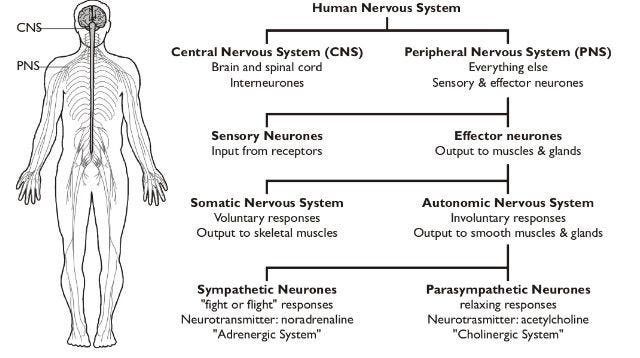
The sympathetic system is your built-in alert mode. It’s the part of you that kept our ancestors alive, scanning for danger and ready to spring into action at a moment’s notice. Many of the postural habits, tension patterns, and shallow-breath tendencies we carry today are echoes of this response—more on that in a future essay. This can show up as tight shoulders, jaw tension, mental overwhelm, or that constant “wired but tired” feeling.
The parasympathetic system is your rest-and-digest mode. Here, the body slows: digestion flows, breath regulates, circulation steadies, and you can finally exhale, knowing—at a subconscious level—that the threat has passed. This is the system that supports creativity, presence, and connection—but it often gets crowded out by modern stressors.
The Vagus Nerve: Master Connector
At the center of these responses is the vagus nerve, cranial nerve X—the body’s longest cranial nerve, running from the brainstem to sensory and visceral organs, all the way down into the gut.
Think of it as a master connector: linking the sensory organs that help us take in the world around us with the vital organs that keep us alive moment to moment. Through these connections, it guides the rhythms of circulation, digestion, breath, and sleep.
The vagus nerve’s role is to detect potential threats before we’re even consciously aware of them, giving the nervous system a head start to prepare the body for stress.
This was essential for survival throughout human history. While constant vigilance is less necessary in the modern world, these deep patterns still shape how we move, feel, and experience life today.
“Your nervous system cannot tell the difference between a real experience and one that is vividly imagined.” ― Maxwell Maltz, New Psycho-Cybernetics
Sensory ⇄ Motor Function
What makes the vagus nerve unique among cranial nerves is that it carries both sensory (afferent) and motor (efferent) functions.
The sensory pathways bring information from the body to the brain, helping it understand the external and internal environment.
The motor pathways send signals from the brain back to the body, guiding action.
A simple example is touching a hot stove. Sensory signals detect the heat and race to the brain, while motor signals immediately command your hand to pull away—often before you’re even consciously aware of the burn. This split-second loop illustrates how fast and responsive the vagus nerve can be.

Awareness in Practice
Your vagus nerve is always working in the background, guiding how you respond to the world and how you settle into yourself. The more awareness we bring to it, the more we can invite balance between alertness and ease, tension and relaxation.
These nervous system patterns often show up as tension in the shoulders and chest, shallow breathing, fatigue, or a sense of being “stuck” in the body.
But bringing gentle attention to the vagus nerve can help regulate these patterns…
Here are a few ways to explore and tune your vagus nerve:
01. Notice your breath – Where in your body do you feel it most? Can you lengthen the exhale slightly to invite ease?
02. Experiment with sound – Gentle humming or ujjayi breath sends subtle vibrations through your throat and chest, stimulating the vagus nerve.
03. Scan your body – Identify areas of tension from sympathetic activation. Breathe into those areas and see if they soften.
04. Play with pacing – Alternate moments of alertness and stillness in your day, observing how your body naturally shifts between sympathetic and parasympathetic states.
By bringing awareness to your vagus nerve, you’re not just observing your body—you’re engaging in a subtle dialogue with it.
Every breath we take,
Each sound we make,
Every pause…
can be an invitation to cultivate balance, release tension, and reconnect with your innate capacity for calm and presence.
Over time, these small moments of attention ripple through your nervous system, helping you move more freely, feel more grounded, and respond to life with greater ease.
Exploring your nervous system is something you can do on your own, but it’s a whole other experience when shared in community. My retreat in British Columbia next month is designed as a space to move, breathe, and practice together, tuning into the wisdom of your body and the subtle rhythms of your vagus nerve. There’s just one spot left—if you’re ready to reconnect with your body and cultivate deep ease, I’d love to hold that space for you. Details can be found [here →].